
Tom Njoroge is building AI for a healthcare system that cannot afford abstraction. His work begins from a constraint most technology founders in health never have to confront directly: when diagnosis is slow or unavailable, people do not wait. They deteriorate, or they disappear from care altogether.
Co-Founder & CEO, Neural Labs Africa
Kenya
Njoroge grew up in Nairobi, Kenya, in a health system where access to specialists is uneven and often centralized. Radiologists are scarce. Imaging equipment is expensive. Even when X-ray machines exist, interpretation can be delayed by days or weeks. These delays are not edge cases. They are structural. And they shape outcomes.
Neural Labs Africa was founded in 2021 to address that reality. The company builds AI-powered medical imaging tools designed to assist clinicians in reading and prioritizing diagnostic images, particularly X-rays, in real time. The focus is not novelty. It is throughput. How quickly can a clinician identify what matters? How reliably can they rule out what does not?
The company’s core platform applies computer vision and deep learning to screen images for a range of conditions, including tuberculosis, pneumonia, and other cardiopulmonary abnormalities. The system highlights potential findings and flags urgent cases for review. It does not replace radiologists. It compensates for their absence.
This distinction is central to Njoroge’s approach. Neural Labs Africa is built to operate in environments where clinical capacity is limited, infrastructure is inconsistent, and workflows are already stretched. The technology is designed to integrate into existing imaging processes without requiring expensive new hardware or extensive retraining.
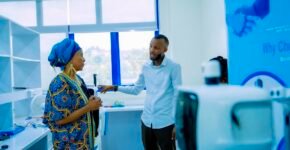
Njoroge’s background is technical, with training in machine learning and data science. But the company’s orientation is operational. Neural Labs Africa works directly with hospitals and clinics to validate its tools in real-world settings. The company has conducted clinical trials and pilots in Kenya and Senegal, testing model performance against local disease prevalence and imaging conditions rather than benchmark datasets optimized for high-income contexts.
That local grounding addresses one of the most persistent problems in health AI: bias introduced by data that does not reflect where models are deployed. Imaging data from African hospitals differs in quality, disease distribution, and patient demographics from data commonly used to train global models. Neural Labs Africa treats this not as a limitation, but as the starting point.
The company has received external validation through participation in global innovation programs, including support from the UNICEF Venture Fund’s AI and Data Science initiative. This backing signals not just technical promise, but alignment with public-interest deployment models where scale is measured in access rather than margin alone.
Njoroge’s public statements consistently emphasize that AI in healthcare must be accountable to clinicians. Neural Labs Africa positions its tools as decision support systems, designed to reduce cognitive load and improve consistency rather than automate judgment. This framing reflects a pragmatic understanding of clinical trust. Adoption depends not on model accuracy alone, but on whether practitioners feel supported rather than overridden.
The stakes are significant. In many African countries, tuberculosis remains a leading cause of death. Early detection is critical, yet screening capacity is limited. AI-assisted imaging offers a way to expand screening without proportionally expanding specialist headcount. But only if models are trained, validated, and deployed responsibly.
Neural Labs Africa operates within that tension. Scaling too quickly risks eroding trust. Moving too slowly risks irrelevance. Njoroge’s strategy has been to build credibility first, through clinical collaboration, transparent validation, and incremental deployment.
What distinguishes Njoroge as an entrepreneur is his refusal to frame AI as a shortcut. His work treats healthcare as a system with constraints that technology must respect. Neural Labs Africa is not attempting to leapfrog infrastructure. It is attempting to work within it, augmenting what exists rather than imagining it away.
As AI increasingly enters diagnostic workflows globally, the question is no longer whether these tools will be used, but where they will work well. Tom Njoroge is building for contexts that are often excluded from that question altogether.
His company’s success will not be measured by press releases or platform reach. It will be measured by whether a clinician in a busy public hospital can make a faster, more confident decision when it matters.
In healthcare, that is the only metric that counts.
Click the ⤢ Icon to View the Magazine in full Screen for Best View
Designed as a seasonal publication, Voice of Development brings together research, reporting, and analysis meant to be read deliberately and revisited over time. Winter 2026 is a starting point: an attempt to answer, with clarity and restraint, what AIs can actually do—and what they cannot do.

Disclaimer: VoD Capsules are AI-generated. They synthesize publicly available evidence from reputable institutions (UN, World Bank, AfDB, OECD, academic work, and other such official data sources). Always consult the original reports and primary data for verification.