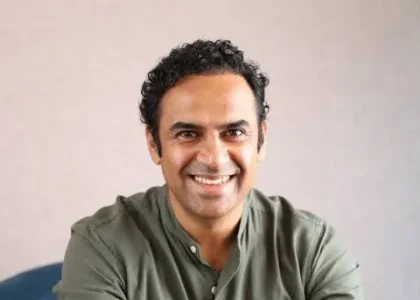
Kate Kallot does not talk about artificial intelligence as a frontier. She talks about it as an inheritance.
Founder & CEO, Amini
Central African Republic / France / Kenya
Kallot was born in France to parents exiled from the Central African Republic, a country whose name is often invoked only in the context of crisis, despite sitting atop extraordinary mineral wealth. Diamond, gold, uranium, cobalt, lithium — the raw materials of both past and future industrial revolutions — lie beneath its soil. What the country has historically lacked is not resources, but infrastructure and agency.
This contradiction shaped Kallot long before she entered technology.
Her grandfather, a French-educated INTERPOL agent, returned to the newly independent Central African Republic with the ambition of helping build a functioning state. He was assassinated under dictatorship. Her parents fled. That history, Kallot has said, never left her. It informed how she understood extraction, power, and who gets to decide how value is created.
Kallot trained as an engineer and built her early career inside the global semiconductor industry, working at companies such as Arm, Intel, and Nvidia. These were the firms designing the computational backbone of the modern world. From the inside, she saw how intelligence was manufactured, scaled, and geographically concentrated. She also saw what was missing.
Africa, and much of the Global South, was largely absent from the data, compute, and infrastructure layers that define contemporary AI systems. Not underserved — structurally excluded.
That realization led to the founding of Amini in 2022.
Amini is an environmental intelligence company that applies artificial intelligence to satellite imagery, sensor streams, and climate datasets to generate high-resolution, localized insights for agriculture, land-use planning, climate risk, and insurance. The company’s work addresses a quiet but foundational problem: most global models are built on incomplete or distorted data from regions like Africa. Decisions about food security, financial risk, and climate resilience are therefore made using global averages that do not reflect local reality.
Kallot’s framing is precise. Data, in her view, is not a byproduct of development. It is infrastructure.
Amini aggregates fragmented environmental data and trains models that are grounded in local conditions rather than generalized assumptions. The output is actionable intelligence — not abstract forecasts, but tools that can be used by farmers, insurers, governments, and planners to make decisions that affect livelihoods.
One early deployment illustrates the logic. By improving risk visibility for agricultural insurance providers, Amini enabled a multinational firm to reduce farmers’ insurance premiums across East Africa by approximately 30 percent. The reduction did not come from subsidies or policy changes, but from better information. Risk that could be measured could be priced more fairly.
This emphasis on practical outcomes runs through Amini’s strategy. The company is not building general-purpose AI. It is building purpose-built systems for environments where margin for error is small and resources are constrained.
Infrastructure, however, quickly emerged as a second bottleneck.
Advanced AI systems require graphics processing units and data centers, which are overwhelmingly concentrated in a handful of countries. Africa hosts less than one percent of the world’s data centers. Kallot recognized that without local compute, even locally sourced data would be extracted, processed elsewhere, and sold back — reproducing the same extractive patterns under a new technological guise.
Amini’s response was to invest directly in localized computing infrastructure. In Kenya, the company operates an AI hub that provides access to compute capacity. In Côte d’Ivoire, Amini partners with government to develop national AI infrastructure. In Barbados, the company has deployed micro–data centers housed in shipping containers, designed to be operational within months and to function at a fraction of the scale of hyperscale Western facilities.
These are not symbolic gestures. They reflect a deliberate strategy to keep intelligence production closer to where data originates and decisions are made.
Kallot is explicit about the limits of ambition. Amini is not trying to compete with frontier labs on scale or generality. “We’re building purpose-built AI for the challenges we’re facing,” she has said. The company focuses on domains where localized intelligence can materially change outcomes, rather than abstract benchmarks.
The market has responded. Amini’s revenue grew sharply in its early years, reflecting demand from sectors exposed to climate volatility and data scarcity. The company’s work has attracted international attention, including recognition through global leadership platforms focused on impact and technology.
Yet Kallot’s posture remains measured. She speaks less about disruption and more about correction. Less about leapfrogging and more about continuity — ensuring that the next technological cycle does not repeat the exclusions of the last.
What places Kate Kallot among the entrepreneurs to watch is not only what she is building, but where she is building from.
She operates across multiple identities — Central African, French-born, Kenya-based — and refuses to flatten that complexity into a single narrative. Amini reflects that stance. It is neither a charity nor a purely extractive startup. It treats data as civic infrastructure and AI as a public-interest system that must be situated, accountable, and grounded.
In an era where artificial intelligence is often framed as inevitable, Kallot’s work insists on choice. Who builds. Where compute lives. Whose realities are encoded.
Amini is her answer to those questions — and a reminder that the future of AI will be shaped as much by geography and history as by algorithms.
Click the ⤢ Icon to View the Magazine in full Screen for Best View
Designed as a seasonal publication, Voice of Development brings together research, reporting, and analysis meant to be read deliberately and revisited over time. Winter 2026 is a starting point: an attempt to answer, with clarity and restraint, what AIs can actually do—and what they cannot do.

Disclaimer: VoD Capsules are AI-generated. They synthesize publicly available evidence from reputable institutions (UN, World Bank, AfDB, OECD, academic work, andother such official data sources). Always consult the original reports and primary data for verification.