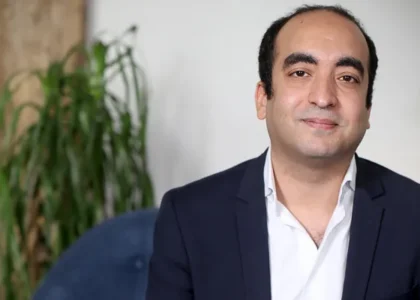

Karim Beguir founded InstaDeep in 2014, years before artificial intelligence became a boardroom priority and long before Africa was considered a credible origin point for frontier AI companies. At the time, machine learning was still largely confined to research labs and niche industrial applications. Beguir believed it would become foundational infrastructure for decision-making in complex systems, and he built accordingly.
Beguir trained in applied mathematics, studying at École Polytechnique in France and later undertaking research fellowships in the United States, including at New York University. His early career combined academic research with applied machine learning roles, including work at IBM Research. That blend of theory and application would later define how InstaDeep positioned itself: research-driven, but oriented toward real industrial problems.
InstaDeep was founded in Tunisia, not as a statement about geography, but as a function of opportunity. Beguir has spoken publicly about choosing to build where talent existed but ecosystems were underdeveloped, believing that deep technical capability, not location, would ultimately determine credibility. From the beginning, the company focused on reinforcement learning and advanced optimization, targeting problems that traditional software could not solve efficiently.
The company’s early work centered on logistics and industrial optimization, applying machine learning to scheduling, routing, and manufacturing problems with large numbers of variables. Over time, InstaDeep expanded into life sciences, where similar optimization challenges exist at a biological scale. This shift proved decisive.
In collaboration with BioNTech, the German biotechnology company, InstaDeep applied its AI systems to genomics, protein engineering, and drug discovery workflows. The partnership began as a research collaboration and deepened over several years. In 2023, BioNTech announced its acquisition of InstaDeep, agreeing to pay approximately £362 million upfront, with additional performance-based payments bringing the total potential value to around £562 million.
The acquisition was one of the largest exits involving a company founded in Africa and was framed by BioNTech as a strategic investment in long-term AI capability. InstaDeep became a core part of BioNTech’s artificial intelligence platform, supporting research and development in areas such as mRNA design and biological sequence analysis.
Importantly, InstaDeep did not dissolve into BioNTech’s operations. The company continues to operate as a distinct AI unit, with teams across Europe, Africa, and the United States, and it maintains external enterprise clients beyond biotechnology. Beguir has stated publicly that InstaDeep will continue to serve multiple industries, reflecting its identity as a general-purpose decision-intelligence company rather than a single-sector tool.
Beguir’s role as an entrepreneur extends beyond company building. He is active in global AI forums and has been recognized for his leadership, including being named a TIME100 Impact Leader. He has also played a role in strengthening technical communities, particularly through involvement with initiatives such as Deep Learning Indaba, which focuses on advancing AI research capacity across Africa.
What distinguishes Karim Beguir is consistency. His public statements over the years emphasize depth over speed, research over spectacle, and long-term capability over short-term narratives. InstaDeep’s trajectory mirrors that philosophy. The company grew quietly, built credibility through research and enterprise deployment, and reached scale through a strategic acquisition rather than public hype.
Karim Beguir belongs on a list of entrepreneurs to watch because his work illustrates a broader shift in where serious technology companies can originate. InstaDeep demonstrates that frontier AI can be built, scaled, and acquired from outside traditional centers of power, provided the underlying work is rigorous enough.
As artificial intelligence moves deeper into science, manufacturing, and infrastructure, founders who understand both research and deployment will shape its real impact. Beguir has spent more than a decade operating at that intersection. The result is a company that did not need to announce its arrival. It was validated by the systems that chose to rely on it.
Click the ⤢ Icon to View the Magazine in full Screen for Best View
Designed as a seasonal publication, Voice of Development brings together research, reporting, and analysis meant to be read deliberately and revisited over time. Winter 2026 is a starting point: an attempt to answer, with clarity and restraint, what AIs can actually do—and what they cannot do.

Disclaimer: VoD Capsules are AI-generated. They synthesize publicly available evidence from reputable institutions (UN, World Bank, AfDB, OECD, academic work, and other such official data sources). Always consult the original reports and primary data for verification.