Amazon’s robotics journey shows how automation, human labor, and AI co-evolve—less about replacing people, more about redesigning the economics and physics of fulfillment at planetary scale.
Disclaimer: VoD Capsules are AI-generated. They synthesize publicly available evidence from reputable institutions (UN, World Bank, AfDB, OECD, academic work, and other such official data sources). Always consult the original reports and primary data for verification.
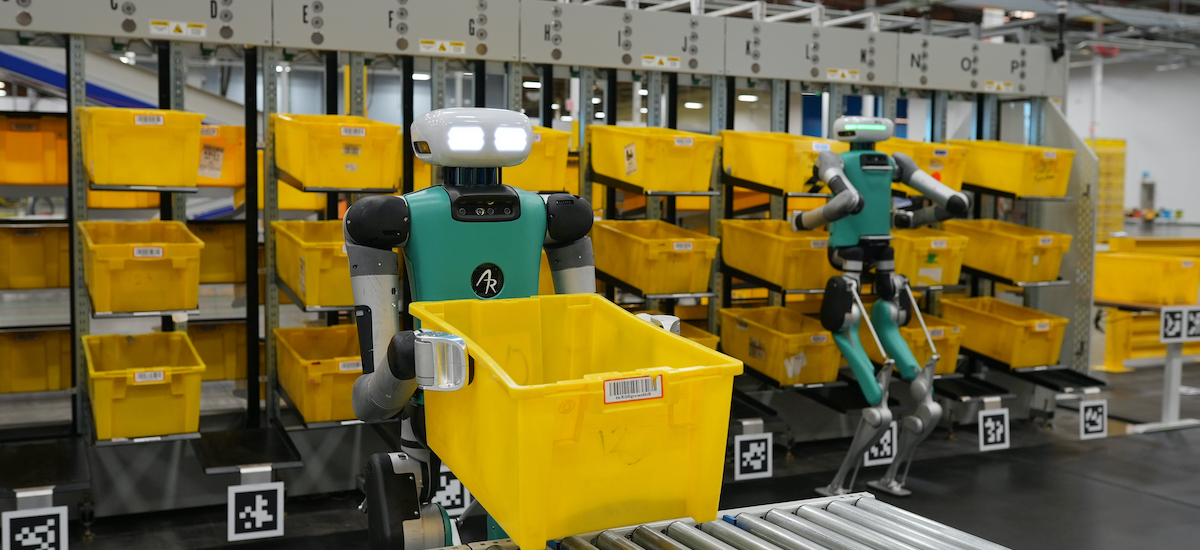
Since acquiring Kiva Systems in 2012 (later rebranded Amazon Robotics), Amazon has deployed 750,000+ robots across its fulfillment network. These systems—ranging from mobile drive units to AI-enabled robotic arms—have transformed storage density, picking speed, worker ergonomics, and cost structures. According to Amazon disclosures, robotics has reduced fulfillment costs per unit, enabled same-day delivery at scale, and reshaped warehouse labor toward supervision, maintenance, and problem-solving roles. Recent innovations like Proteus signal a shift toward autonomous robots that safely operate alongside humans, marking a new phase where AI perception and mobility converge. The strategic direction is clear: modular automation, human-in-the-loop design, and continuous experimentation rather than a single “lights-out” warehouse model.
Era: 2012–present
What they do: Move entire shelving pods to human pickers.
Why they mattered:
Verdict: 🟢 Massive success. This is the backbone of Amazon fulfillment.
Era: 2018–present
What they do: Use computer vision + suction/grippers to pick, sort, and singulate items.
Key challenge: Item variability (size, texture, deformability).
Verdict: 🟡 Incremental but real progress—still paired with humans.
Era: 2022–present
What it does: Fully autonomous floor robot that navigates around people without cages.
Why it’s different:
Strategic significance: This is Amazon’s clearest step toward mixed human–robot teams.
Era: 2020–present
What they do:
Verdict: 🟢 Quiet enablers—less flashy, highly scalable.
Amazon pattern: Pilot aggressively, kill fast, scale selectively.
Amazon doesn’t automate tasks—it re-architects workflows. Robots take over movement, lifting, and pattern recognition; humans handle exceptions, judgment, and dexterity. The warehouse becomes a living system, not a factory line.
Amazon’s bet: humans + robots outperform either alone.
| Report / Study | What it Covers | Official Link |
|---|---|---|
| Amazon Robotics Overview (Amazon) | Official history and current robot fleet | https://www.aboutamazon.com/operations/amazon-robotics |
| Proteus Autonomous Robot (Amazon, 2022) | First fully autonomous AMR | https://www.aboutamazon.com/stories/amazon-robotics-autonomous-robot-proteus-warehouse-packages |
| World Economic Forum (2023) | Automation and jobs | https://www.weforum.org/reports/the-future-of-jobs-report-2023 |
| MIT CSAIL Research | Robotics and manipulation limits | https://www.csail.mit.edu |
| McKinsey Global Institute | Automation economics | https://www.mckinsey.com/mgi |
If you want, I can also map Amazon’s robotics stack, compare it to Alibaba or Ocado, or break down what this means for the future of work globally.
VoDGPT is an AI system powered by OpenAI, and it can make mistakes.
Use VoD Capsules as a starting point for understanding; always review the linked reports and verify critical information.